

Luxury Edition Archive

LUX-001 — DOLLS
A fragile assemblage of antique doll bodies and fragments is suspended against a pale interior wall, entangled in hand-crocheted lace that functions simultaneously as veil, net, and shroud. Limbs hang at irregular angles, their scale and patina signaling age, domestic use, and quiet neglect. The photograph documents an interior found arrangement rather than a constructed tableau, preserving the physical evidence of time, touch, and material fatigue embedded within the objects themselves.

LUX-002 — DOLLS
Two dolls occupy the frame in close proximity: the foreground figure marked by extensive cracking, flaking paint, and exposed substrate, while a second, newer doll emerges partially from behind, its surface intact and expression softened by time’s relative absence. The composition isolates the faces and upper torsos, compressing spatial depth and emphasizing material contrast—aged composition and modern plastic, deterioration and preservation—without theatrical staging or intervention.

LUX-003 — DOLLS
A porcelain figure is presented in a state of composed stillness, its polished surface and softened features suggesting innocence carefully maintained. The frame is quietly unsettled by the presence of adult hands at the margins, revealing the act of positioning and control that underlies the scene. What appears gentle is revealed as constructed; what appears autonomous is, in fact, authored. The photograph operates within the archive as an examination of how childhood is staged, preserved, and managed through objects designed to absorb projection.

LUX-004 — DOLLS
Disarticulated forms are suspended against a domestic backdrop, where lace, curtain fabric, and soft light evoke familiarity while simultaneously denying comfort. Limbs appear detached and elevated, transformed from functional objects into relics, while the central figure hangs in partial collapse—neither fully present nor fully erased. The photograph documents a moment where childhood artifacts are stripped of narrative cohesion, revealing how innocence can be fragmented, displayed, and recontextualized within private spaces.

LUX-005 — DOLLS
Three dolls occupy the frame, each present only in part: one face nearly intact and centered, another partially cropped at the edge, and a third reduced to an isolated arm resting across the primary body. The photograph is constructed through fragmentation rather than wholeness, with porcelain skin, worn paint, and surface abrasions registering time through contact and handling. Closed eyes, parted lips, and the weight of the arm introduce proximity without reciprocity, allowing the image to examine how manufactured bodies accrue history through use, storage, and repetition.

LUX-006 — DOLLS
A wire basket contains a dense accumulation of doll limbs—legs, feet, and partial torsos—stacked and compressed into a single vessel. The bodies are detached at their joints, their smooth vinyl surfaces marked by scuffs, discoloration, and exposure. Toes curl outward, knees bend unnaturally, and the repetition of form collapses individuality into pattern. The basket functions less as a container than as a boundary, holding together remnants whose original purpose has been rendered obsolete through separation and wear.

LUX-007 — DOLLS
Multiple dolls are pressed together within a confined space, their bodies overlapping and partially obscuring one another. Faces tilt at differing angles, some upright, others inverted or cropped by the frame, creating a compressed field of expressions that range from intact to visibly worn. Cracked paint, dulled glass eyes, and frayed fabric indicate age and repeated handling, while the tight proximity collapses individual identity into a shared physical condition. The image records not a single figure, but a collective state of containment.

LUX-008 — DOLLS
A seated doll is positioned in profile against a dark wooden backdrop, its cracked porcelain face turned toward the light. The surface of the head and limbs shows extensive crazing and wear, while a ribboned garment and gauze-like fabric soften the severity of the figure’s condition. A second doll appears partially inverted in the foreground, its head cropped and body receding from focus, reinforcing a layered arrangement in which completeness and fragmentation coexist within the same frame.

LUX-009 — DOLLS
A single doll occupies the foreground, facing forward with a full, intact porcelain face framed by a lace bonnet and a richly textured green velvet dress. The surface of the face is smooth and reflective, marked only by fine hairline cracks that register age rather than damage. A second doll appears in the background, softly out of focus and partially obscured, its presence secondary and spatially recessed, reinforcing a clear hierarchy between primary subject and contextual companion.

LUX-010 — DOLLS
A single doll sits behind a child-sized wooden desk, its face partially obscured by a metal typewriter placed squarely in the foreground. Only the doll’s eyes and upper face are visible above the machine, creating a restrained, frontal encounter mediated by the object between viewer and subject. The outdoor setting—grass, temporary flooring, and utilitarian furniture—suggests a staged yet provisional environment, reinforcing the sense of a constructed tableau rather than a domestic interior.

LUX-011 — DOLLS
A small male doll is seated in profile atop a display surface, positioned directly in front of a mannequin head wearing a red beret. The mannequin’s face dominates the frame, its gaze angled slightly away, while the smaller doll appears oriented toward it, creating a deliberate scale contrast and implied relational tension. Below them, a row of vintage brooches and pins introduces a secondary register of ornament and accumulation, grounding the scene within a densely layered interior environment.

LUX-012 — DOLLS
A fabric-bodied doll with a painted, cracked face is seated inside a glass-fronted cabinet, its legs folded into a circular coil beneath it. The figure leans slightly to one side, its blue eyes forward-facing and its red lips intact despite visible fissures running across the face and neck. Reflections in the glass introduce a secondary presence, while a rough mineral formation positioned to the right anchors the scene within a curated, enclosed display environment.

LUX-013 — DOLLS
A mannequin head with closed eyes rests on a slatted wooden shelf, its surface smooth and unmarked, positioned beside a single white boot elevated on a small rectangular base. The background is utilitarian and worn, with horizontal bars and weathered wood creating a provisional display structure. The objects are isolated from one another, aligned but not interacting, suggesting an arrangement assembled for placement rather than use.

LUX-014 — DOLLS
A life-sized male mannequin head with painted blond hair and blue eyes is presented in close view, its surface glossy and carefully finished, with minor abrasions and tonal irregularities visible across the face. A small price tag remains affixed at the neck, while the background dissolves into a softly blurred interior of shelves and objects, situating the figure within a secondary market or storage environment rather than a formal display.

LUX-015 — DOLLS
Three vintage dress forms occupy a compact interior, their linen and canvas surfaces worn, stitched, and discolored through use. The central torso is truncated at the shoulders, flanked by a fuller female form and a partial mannequin obscured by a canvas tote. Surrounding details—hooks, cabinet glass, folded textiles, lamps, and handwritten markings—situate the scene within a working studio or resale environment where objects accumulate through function rather than display.

LUX-016 — DOLLS
A mannequin torso is framed from midsection to knees, its smooth, pale surface marked by small droplets and subtle imperfections. Behind it, a printed harbor scene—boats, dock structures, and a low horizon—creates a layered backdrop that collapses interior display and exterior landscape. The figure stands rigid and frontal, its partial arm visible at the edge of the frame, suspended between objecthood and implied body.
LUX-017 — DOLLS
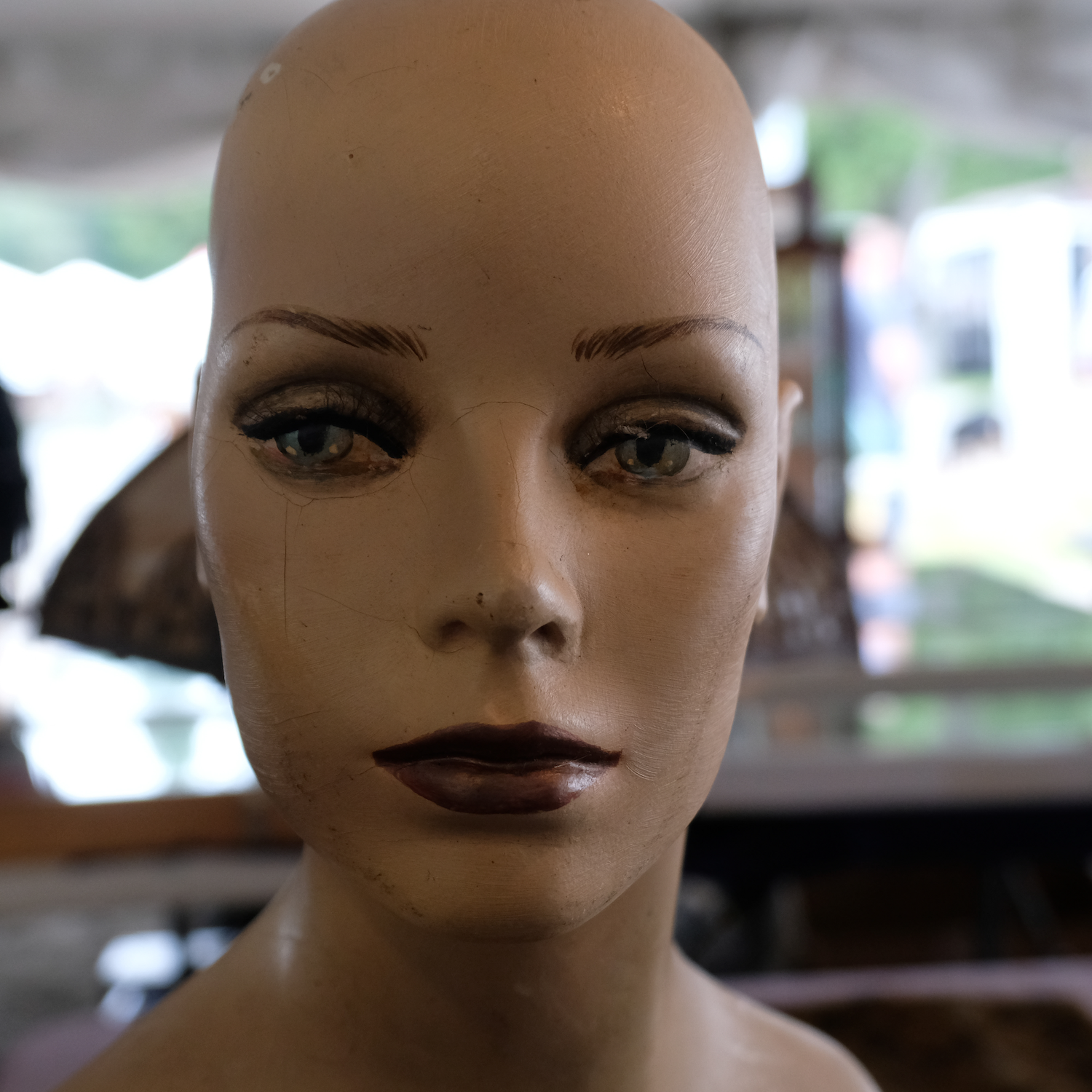
A tightly framed mannequin face fills the image, cropped just beyond the eyes and lips, leaving no contextual cues beyond surface and gaze. Fine cracks, softened pigment, and accumulated wear are visible across the cheeks and nose, while the glassy eyes drift slightly off-axis. The shallow depth and frontal symmetry heighten the sense of proximity, placing the viewer uncomfortably close to an object designed to simulate intimacy.

LUX-018 — DOLLS
The frame isolates a mannequin face at extreme proximity, cropped tightly at the eyes and mouth so that symmetry is implied but never resolved. Fine surface cracking, softened makeup, and uneven pigmentation register immediately, while the eyes—slightly misaligned—hover between gaze and vacancy. The shallow focus collapses any spatial context, forcing attention onto material condition rather than identity.

LUX-019 — DOLLS
The composition presents a partial mannequin face pressed into a shallow, crowded frame, its gaze directed outward but constrained by surrounding objects. A green knit cap truncates the forehead, while the lower face dissolves into shadow and fabric. To the right, a worn red leather bag intrudes, its creases and abrasions echoing the artificial smoothness of the face. The image is structured through compression—objects stacked, surfaces touching, space denied.

LUX-020 — DOLLS
The image presents a dense accumulation of disarticulated fashion dolls contained within a shallow basket, limbs and torsos interlocked in a chaotic vertical heap. One elongated arm rises upright, terminating in a head whose expression remains serenely intact despite the surrounding disorder. Synthetic blond hair spills outward in multiple directions, while plastic surfaces—matte, glossy, and scuffed—collide within a tightly compressed frame that denies hierarchy or orientation.